Do Motion Tokenizers for
Co-Speech Gesture Generation
Encode Gesture Semantics?

Abstract
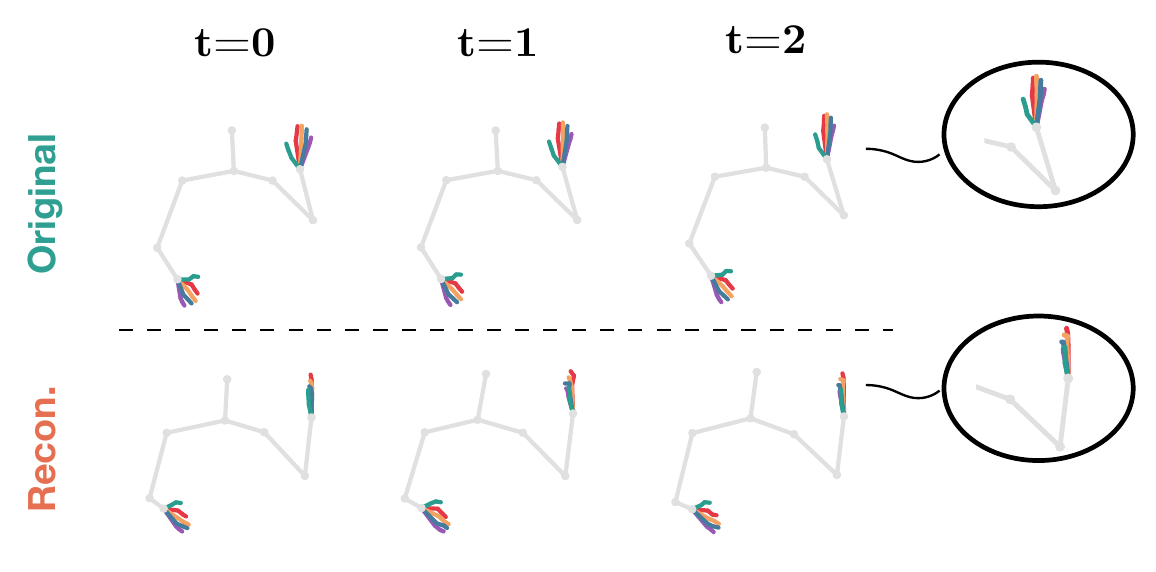
Discrete motion tokenizers encode motion as atomic units and are widely used for co-speech gesture generation. It remains unclear which motion properties, especially those relevant to gesture semantics, are recoverable from these codebooks. We probe a reconstruction-trained codebook using 19 co-speech gesture descriptors spanning from raw motion to abstract communicative function. Results show that geometry and handedness are readily decodable from token embeddings, while motion category is only weakly decoded despite showing systematic differences in discrete code usage. This gap between reconstruction quality and descriptor decodability suggests that reconstruction objectives alone do not guarantee that gesture semantics are captured, and that evaluating codebooks on such properties can guide the design of more semantic motion tokenizers.
Probing embeddings and discrete code usage
Can a descriptor be decoded from pooled token embeddings? Do its classes use different discrete codes? We examine both questions.
Probe pooled embeddings
Mean-pool token embeddings, then predict each descriptor with a linear probe and a shallow MLP.
5-fold cross-validation · Macro-F1Compare code usage
Compare class-average code-frequency profiles and measure how informative individual code activations are.
JS divergence · Mutual information · FDR-corrected testsModel and evaluation details
The primary model has latent dimension 256, codebook size 2,048, and temporal downsampling factor 4. It is trained on combined BEAT and TED motion using position reconstruction and VQ commitment losses.
The body stream contains 8 coarse joints and the hand stream 30 finger joints; a shared decoder reconstructs the full pose. The configuration sweep contains 27 models. Probing is complemented by a comparison with EMAGE and by correlations between macro-F1 and mean per-joint position error (MPJPE).
The linear probe is multinomial logistic regression with balanced class weights; the MLP has one 128-unit ReLU layer. Both use the same five folds and class balancing. Code-level separation is tested with label permutations and Benjamini–Hochberg correction across descriptors within each stream. MI sums the information between individual code presence and descriptor labels.
From motion geometry to communicative function
The 19-descriptor panel combines skeleton-derived measurements with human annotations. Expand a group to see the descriptors.
01Motion dynamics2 descriptors · Manual
Gesture size · Kinematics
02Spatial geometry9 descriptors · Automatic
Left / right vertical position, horizontal position, depth and elbow bend · Hand reach
03Handedness1 descriptor · Manual
Handedness: one hand or both hands
04Annotated spatial form4 descriptors · Manual
Hand orientation · Spatial radial position · Spatial height · Spatial distance
05Handshape1 descriptor · Manual
Handshape: palm, cup, pinch, fist, bunch, fingers, index finger
06Motion pattern and function2 descriptors · Manual
Motion category · Communicative intent
Geometry is more recoverable from pooled embeddings
Both architectures show a similar accessibility gradient: strong spatial geometry and handedness, with much weaker handshape, motion category and communicative intent.
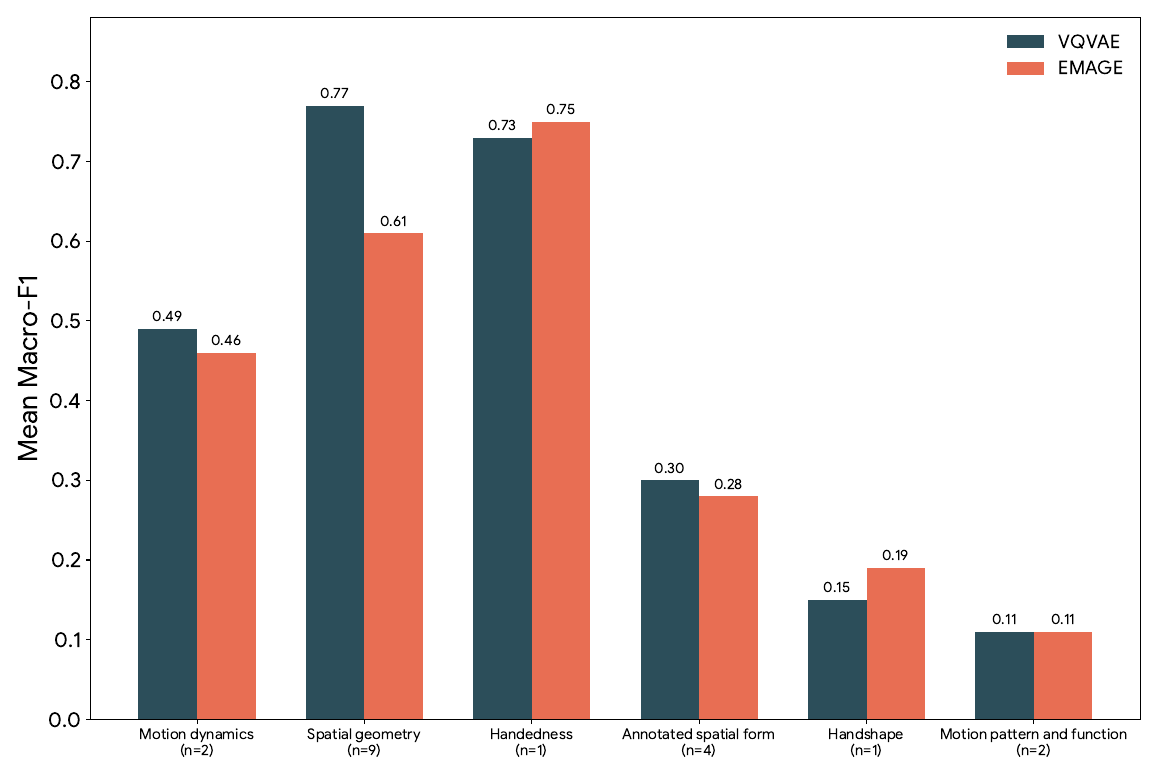
View exact values as a table
| Descriptor group | VQ-VAE | EMAGE |
|---|---|---|
| Motion dynamics | 0.49 | 0.46 |
| Spatial geometry | 0.77 | 0.61 |
| Handedness | 0.73 | 0.75 |
| Annotated spatial form | 0.30 | 0.28 |
| Handshape | 0.15 | 0.19 |
| Motion pattern and function | 0.11 | 0.11 |
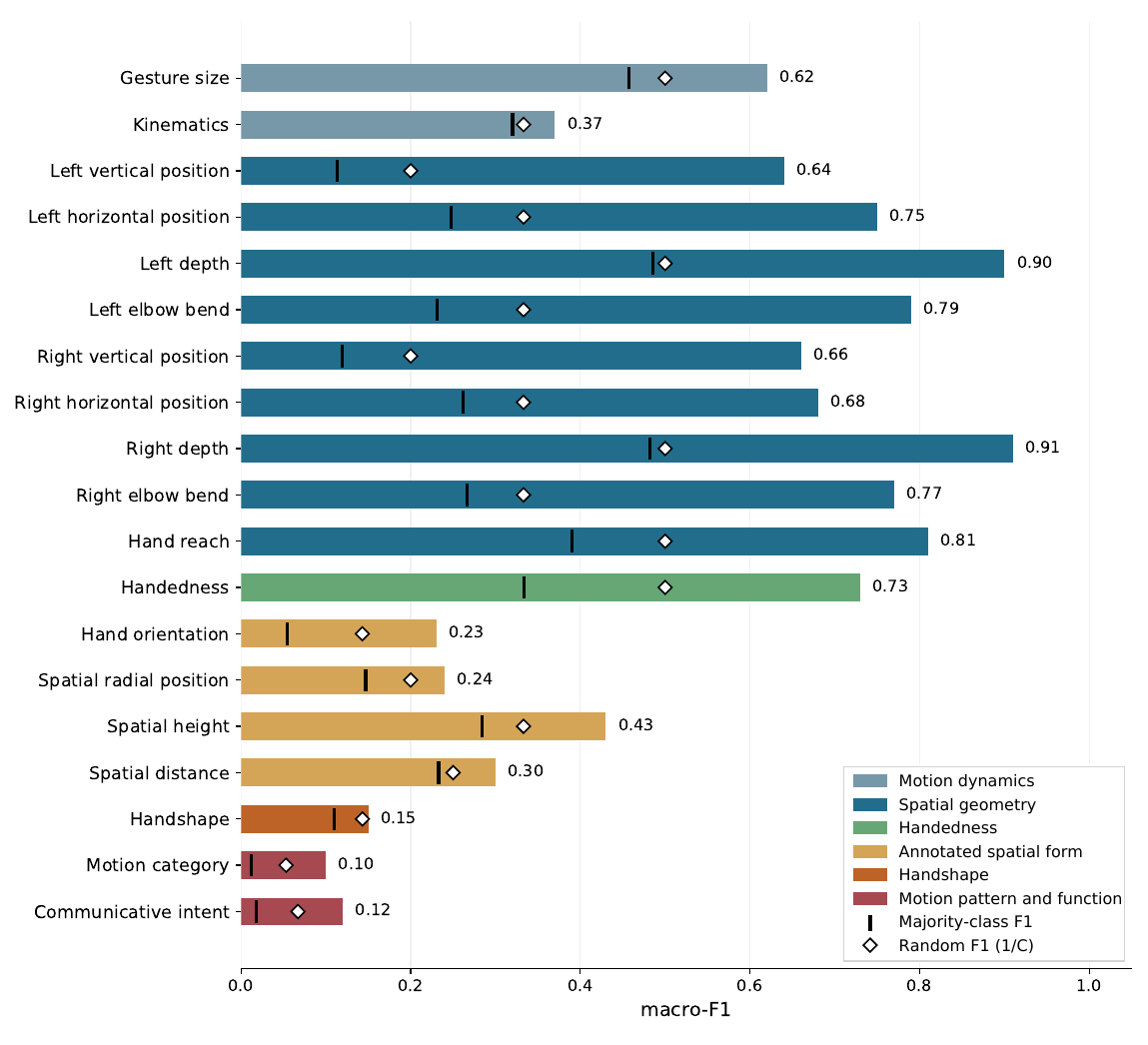
Group-level analysis: probes, code usage and reconstruction
| Descriptor group | N | Linear F1 ↑ | MLP F1 ↑ | MI ↑ | Sig. | r(F1, MPJPE) |
|---|---|---|---|---|---|---|
| Motion dynamics | 2 | 0.49 ± 0.07 | 0.52 ± 0.08 | 0.35 | 1/2 | −0.26 |
| Spatial geometry | 9 | 0.77 ± 0.01 | 0.74 ± 0.03 | 1.07 | 9/9 | −0.69 |
| Handedness | 1 | 0.73 ± 0.03 | 0.66 ± 0.05 | 0.77 | 1/1 | −0.89 |
| Annotated spatial form | 4 | 0.30 ± 0.01 | 0.31 ± 0.02 | 1.06 | 3/4 | −0.48 |
| Handshape | 1 | 0.16 ± 0.03 | 0.20 ± 0.07 | 1.50 | 0/1 | −0.67 |
| Motion pattern and function | 2 | 0.11 ± 0.02 | 0.12 ± 0.01 | 3.62* | 1/2 | −0.45 |
N: number of descriptors. F1: mean ± SD across descriptors. Sig.: descriptors with significant JS segregation. r: correlation between F1 and MPJPE. * MI is driven primarily by motion category.
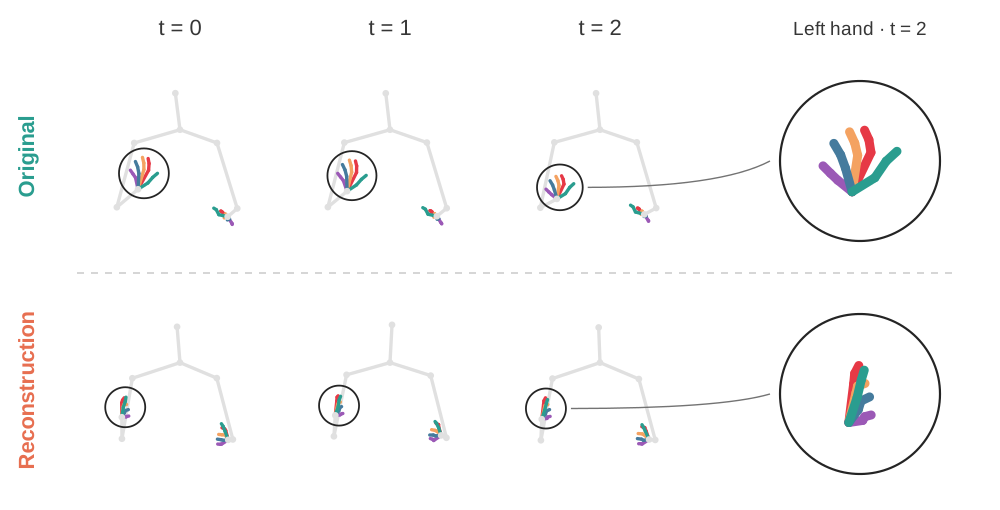
Fine hand details are less faithfully reconstructed
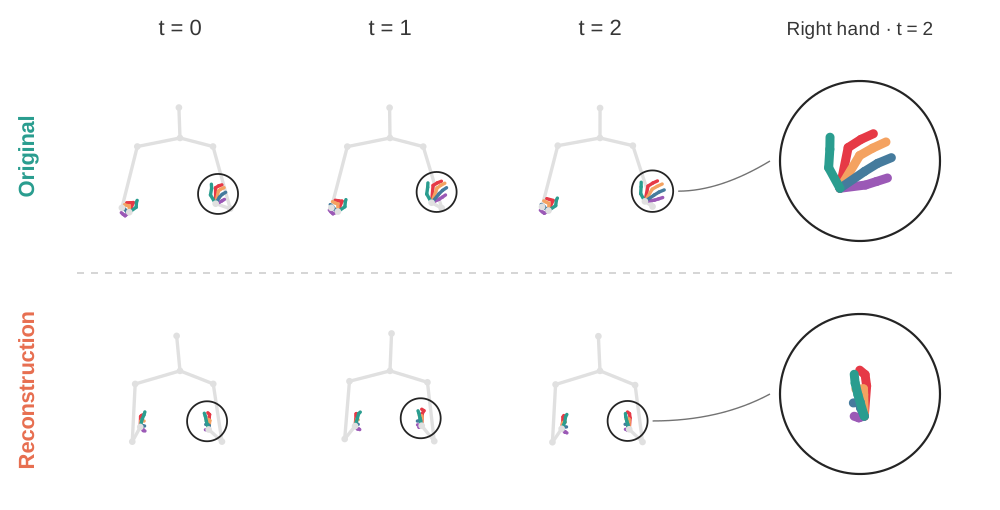
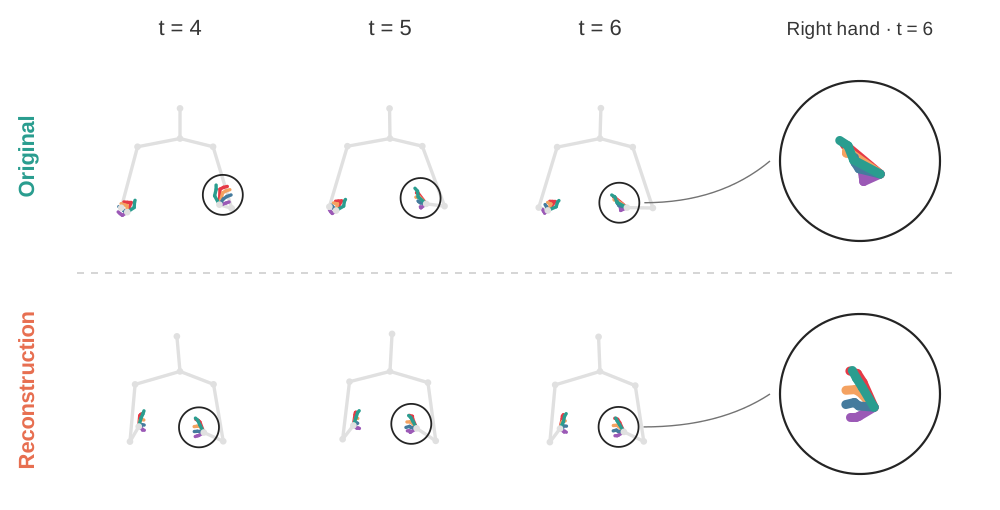
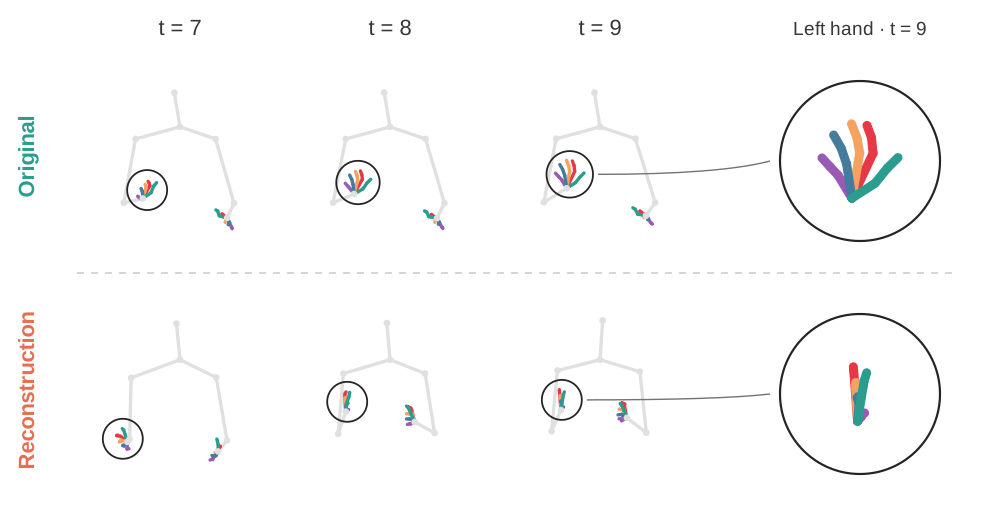
Our qualitative examples show that upper-body geometry is preserved while fine-grained hand poses are averaged out. We attribute this gap in reconstruction quality to the difference in scale between the hands and the upper body.
Evaluate beyond reconstruction
Good reconstruction alone is not a sufficient measure of semantic accessibility.
Use both descriptor probes and code-level analyses to examine what a motion tokenizer preserves.What our findings suggest
Future tokenizers should explicitly preserve communicatively relevant properties. The agreement between two architectures suggests that the observed gradient is not specific to one tokenizer design.
Limitations
Low probe performance does not prove that a property is entirely absent. Our analysis covers 778 TED clips, two skeleton-based tokenizers, and selected pooled representations and probe families; sequence-aware models may access information differently.
BibTeX
@inproceedings{suresh-etal-2026-motion,
    title = "Do Motion Tokenizers for Co-Speech Gesture Generation Encode Gesture Semantics?",
    author = "Suresh, Varsha  and
      Jain, Divij  and
      Liu, Jia  and
      Mughal, M. Hamza  and
      Demberg, Vera",
    editor = "Ghaleb, Esam  and
      Takmaz, Ece  and
      Frassinelli, Diego  and
      Khaertdinov, Bulat  and
      Fern{\'a}ndez, Raquel  and
      Yumak, Zerrin  and
      Ozyurek, Asli",
    booktitle = "Proceedings of the 1st Workshop on Multimodal Interaction in Face-to-Face Dialogue",
    month = oct,
    year = "2026",
    address = "Budapest, Hungary",
    publisher = "Association for Computational Linguistics",
    url = "https://aclanthology.org/2026.mint-1.11/",
    doi = "10.18653/2026.mint-1.11",
    pages = "96--104",
    ISBN = "979-8-89176-482-8"
}Acknowledgments
This work is funded in part by the Deutsche Forschungsgemeinschaft (DFG, German Research Foundation) — GRK 2853/1 “Neuroexplicit Models of Language, Vision, and Action” — project number 471607914.